
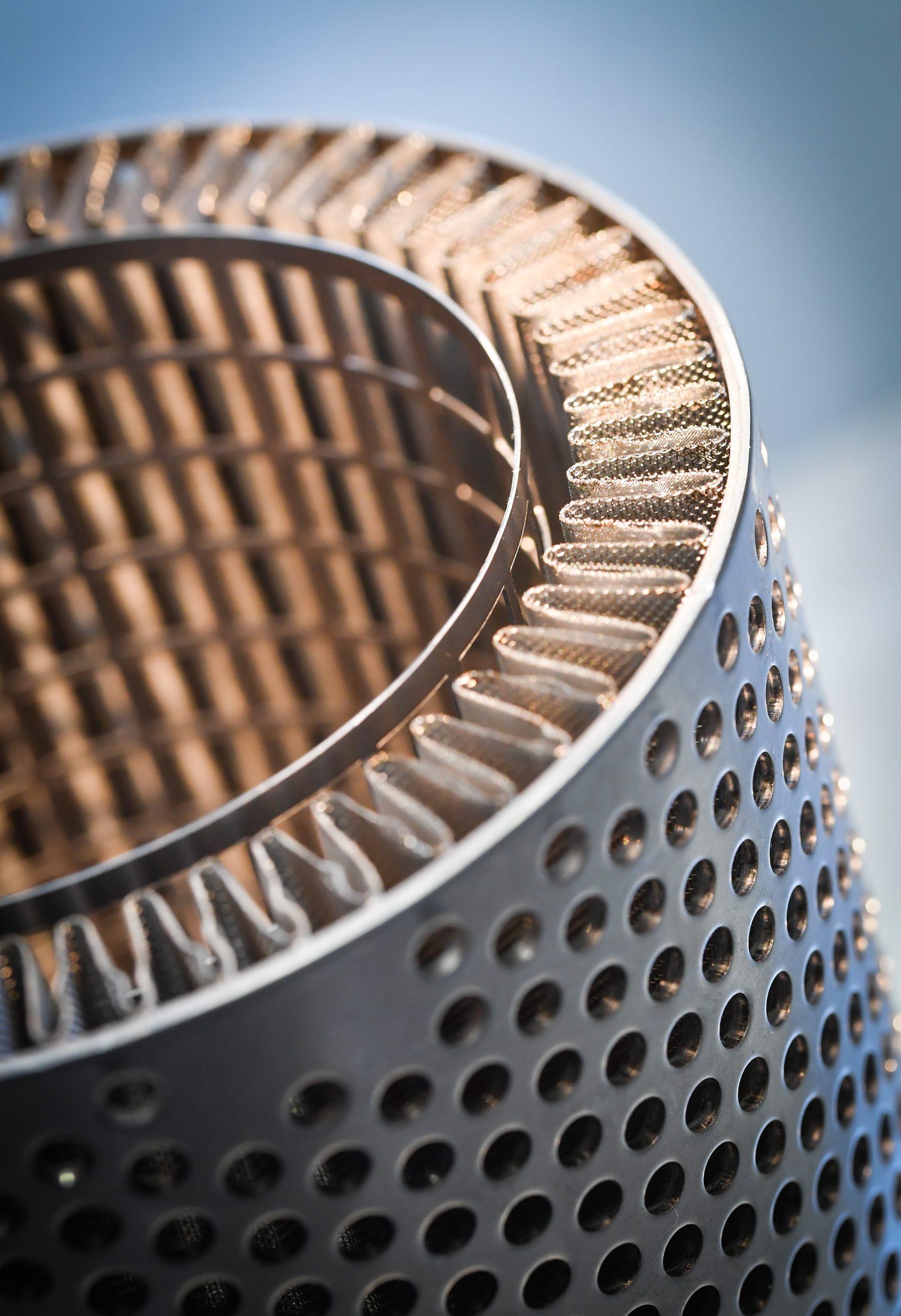
At GUERIN FRANCE, choosing an industrial filtration solution is first and foremost a technical and sustainable decision.
In environmental applications, the comparison between metallic filtration and polymer filtration arises regularly.
Based on our industrial experience, we observe that metallic filtration very often proves to be the most relevant solution in the medium to long term. It offers decisive advantages in terms of reliability, durability and overall environmental impact.
Technical and environmental challenges require high-performance filtration systems
Installations related to environmental applications — process water, effluent treatment, recycling, desalination, clean energies — are subject to severe constraints:
- Continuous operation,
- Presence of abrasive or corrosive particles,
- Variable temperatures and pressures,
- Increasing requirements for reliability and regulatory compliance,
- Reduction of waste and maintenance operations.
In this context, the choice of the filtration medium is not a minor technical detail: it determines the overall performance of the system, its service life and its environmental impact.
Metallic filtration: a solution suited to modern industrial constraints
Polymer filters (engineering plastics, thermoplastics, synthetic fibers) offer undeniable advantages in certain cases:
- Often lower initial purchase cost,
- Lightweight,
- Good chemical resistance to certain fluids,
- Ease of implementation in simple equipment.
They have historically been used in applications with low mechanical stress, moderate temperatures and non-aggressive environments. However, in demanding industrial environmental applications, their limitations quickly become apparent.
Metallic filters have intrinsic characteristics that are particularly well suited to harsh industrial environments. They offer in particular:
- Excellent mechanical strength,
- High pressure resistance,
- Long-term dimensional stability,
- UV resistance,
- Very good resistance to thermal variations,
- High resistance to abrasion from solid particles.
Unlike other solutions, metallic filters maintain their performance over time, even under severe conditions. A properly designed metallic filter can operate for several years without performance loss, whereas other media require frequent replacement.
Metallic filters are not designed as single-use consumables. They can be:
- Cleaned,
- Regenerated,
- Returned to service.
This refurbishment capability significantly reduces:
- Waste volumes,
- Maintenance costs,
- Installation downtime,
- The overall environmental footprint of the system.
They also withstand:
- High temperatures,
- Corrosive environments,
- Abrasive particles,
- Intensive operating cycles.
They are particularly well suited, for example, to industrial water treatment, recycling, desalination, or critical environmental processes.
When considering total costs and overall impacts, metallic filtration is often the more virtuous solution:
- Fewer replacements,
- Less waste,
- Less transportation,
- Less installation downtime.
A well-designed metallic filter fits perfectly into a circular economy approach, based on durability and reuse.
There are cases where polymer remains relevant, and we continue to use it in a reasoned manner in combination with metallic filtration, depending on our customers’ needs (for example, for overmolding applications).
Our role is precisely to choose the right material for the right application.
At GUERIN FRANCE, we choose the most technically and environmentally sound solution, in support of more sustainable industrial processes.